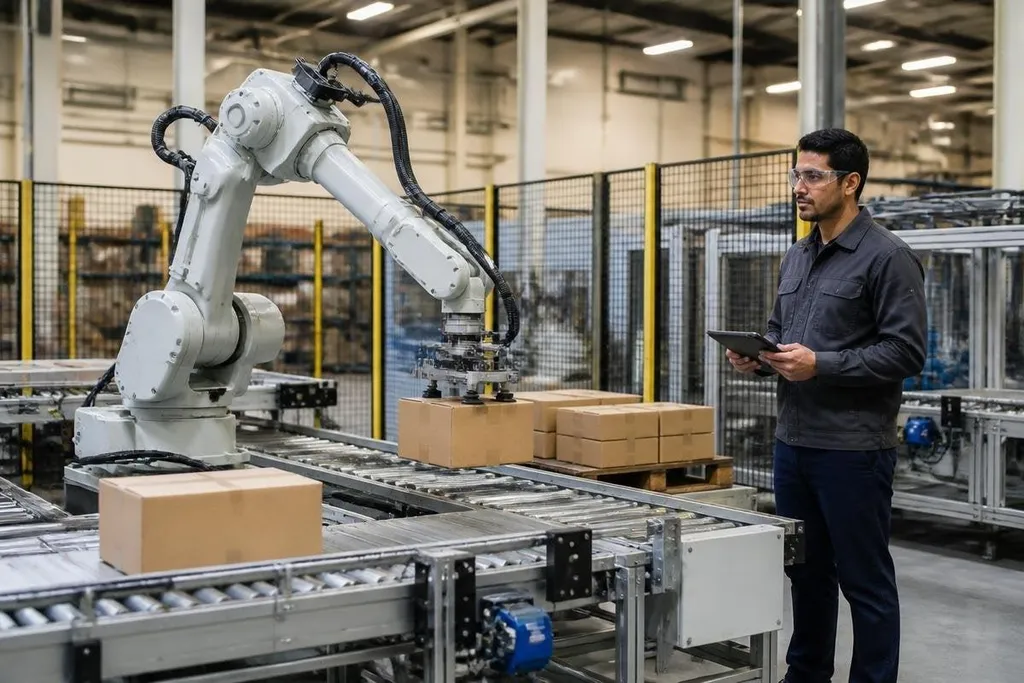
Industrial robots now handle jobs that are repetitive, heavy, hot, or unsafe for people. The change reaches far beyond car plants: robots sort parts, weld frames, move boxes, inspect surfaces, and pack goods.
For an operations manager, the useful question is practical: which task should a robot take over, and what work stays with people?
Quick read
- Robots work best on repeatable tasks with known locations and clear rules.
- A six-axis arm can move through several directions, while sensors help it react to changes.
- The cost includes setup, safety equipment, training, service, and changes to the work area.
Where industrial robots fit
These programmable machines are built to move tools or parts through set paths. A six-axis arm, for example, can turn and move its tool in several directions, which lets it weld, screw, spray, or pick parts from a fixture.
That repeatable motion is useful when a worker would make the same movement hundreds of times each shift. The robot can keep its path and speed steady, while a person checks quality, loads materials, handles exceptions, or changes the production run.
Factories also use mobile robots to carry parts between work areas. These machines often use LiDAR, cameras, or other sensors to detect walls, people, and objects in their path. The robot then changes its route or stops when the space does not match its map.
The result depends on the task. A robot can move a box from one marked point to another with little change. It has a harder time when boxes arrive in random positions, labels are hidden, or soft items change shape.
What changes for workers
Automation changes jobs in different ways. A person may spend less time lifting parts and more time checking the robot, loading a program, or fixing a fault. That shift calls for training in basic controls, sensors, grippers, and safety procedures.
Some tasks remain difficult for robots because they need touch, judgment, or quick changes. A worker may sort damaged goods, handle a part with an odd shape, or decide whether a product meets a visual standard that the camera cannot judge reliably.
Safety also changes. A robot arm can move with enough force to injure someone, so a cell may need guards, interlocked doors, light curtains, scanners, and an emergency stop. These parts affect the layout and the cost before the first production run begins.
A good installation gives people a clear role. The robot handles the repeatable motion, while workers manage changes, faults, and decisions that still need human judgment.
The limits behind the sales pitch
These machines are precise when the work area stays controlled. They can lose that advantage when parts shift, lighting changes, tools wear, or the feed system sends parts in the wrong position.
Integration can take longer than buying the arm. The company may need a custom gripper, a conveyor, a vision system, a safety review, and software that connects the robot to existing equipment. Each added part creates another point to test and service.
The robot also needs a clear measure of success. A faster arm does not help if workers wait for parts, the gripper drops items, or safety stops interrupt the line. Check the full task from material arrival to finished product.
A speed figure can't tell you whether an industrial robot fits your line. Robot24.com can connect a named machine with its work site, task, price, and test result before you compare it with your own process.
A practical buying checklist
Use these checks before you approve an industrial robot project:
- Name the task: Record the movement, part size, cycle time, and number of repeats in one shift.
- Check the input: Test the robot with real parts, including damaged, dirty, or badly placed items.
- Set the payload: Include the gripper and any tool in the weight calculation, not only the part.
- Plan the cell: Mark guards, scanners, access doors, service space, and the emergency stop before installation.
- Count the people: Assign who loads parts, clears faults, changes programs, and checks quality.
- Measure the full line: Compare finished units per hour after stops, rework, changeovers, and maintenance.
I think the best industrial robot projects start with one dull task and a clear measure, then grow only when the first cell works.
The next useful test is simple: run the task with real parts for a full shift, record every stop, and see whether the robot saves time after the extra equipment and training are counted.